The relationship between the ionic charge and boiling/melting points
For ions of similar size, the strength of the forces of attraction between the ions will depend on the size of their charge. For this reason, magnesium oxide (Mg²+O²-) has a higher melting and boiling point than sodium chloride (Na+Cl-). The more electrons that have been transferred, the stronger the bond because of the stronger electrostatic forces.
Showing posts with label ionic bonding. Show all posts
Showing posts with label ionic bonding. Show all posts
Thursday, 16 May 2013

1.33 & 1.34 understand ionic bonding as a strong electrostatic attraction between oppositely charged ions
Electrostatic attraction in ionic bonding
The electrostatic attraction keeps the ions bonded, and as it is very strong, it takes a lot of energy to break these bonds.
For this reason, ionic compounds have very high melting and boiling points, because of the amount of energy needed to break these strong bonds between oppositely charged ions.
The electrostatic attraction keeps the ions bonded, and as it is very strong, it takes a lot of energy to break these bonds.
For this reason, ionic compounds have very high melting and boiling points, because of the amount of energy needed to break these strong bonds between oppositely charged ions.
1.32 explain, using dot and cross diagrams, the formation of ionic compounds by electron transfer, limited to combinations of elements from Groups 1, 2, 3 and 5, 6, 7
Dot and cross diagrams
Dot and cross diagrams are used to show electron transfers, and the creation of ions.
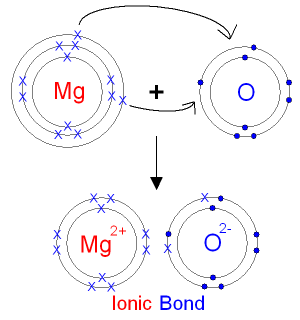
As you can see, the magnesium atom gives 2 electrons to the oxygen atom, so an ionic bond is created and therefore, 2 ions are created; the magnesium atom becomes a positive ion, losing 2 electrons and the oxygen atom becomes a negative ion, gaining 2 electrons.
Dot and cross diagrams are used to show electron transfers, and the creation of ions.
As you can see, the magnesium atom gives 2 electrons to the oxygen atom, so an ionic bond is created and therefore, 2 ions are created; the magnesium atom becomes a positive ion, losing 2 electrons and the oxygen atom becomes a negative ion, gaining 2 electrons.
Subscribe to:
Posts (Atom)